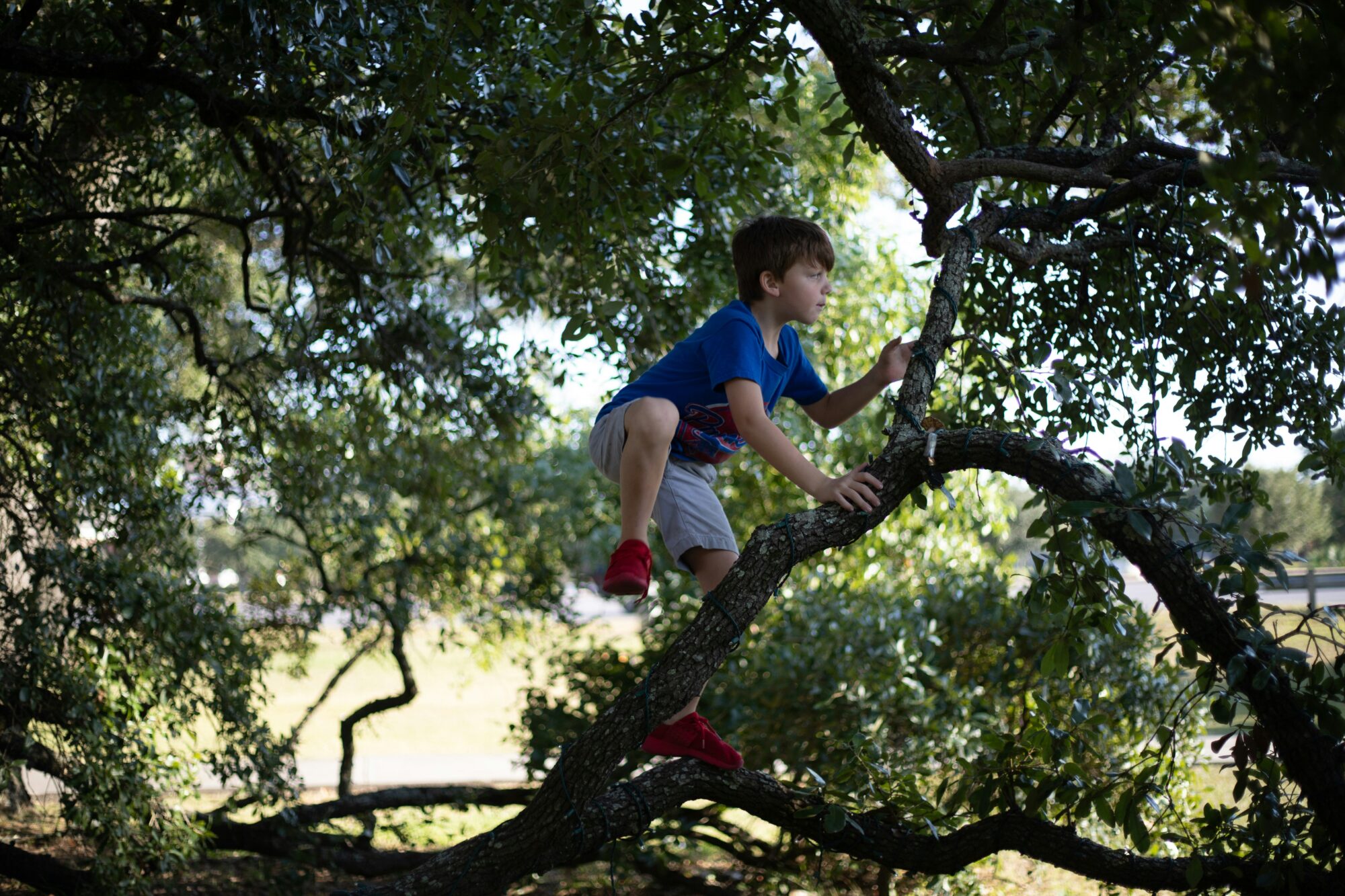
Picture this: Your child is at the park, scaling the highest point of the jungle gym. Your heart leaps into your throat, and without a second thought, the words fly out of your mouth: “Be careful!”
It’s a natural, loving reaction. We are wired to protect children from harm. But what if this default phrase, while well-intentioned, is actually doing them a disservice? What if we could swap fear-based warnings for language that builds competence, critical thinking, and a deeper connection to the world around them?
This is the shift from “Be careful!” to “Be aware!” A simple change in vocabulary that can transform how children experience outdoor play.
The Problem with “Be Careful”
“Be careful” is vague and often loaded with adult worry. When children hear it, they don’t receive useful information. Instead, they hear our anxiety.
It can:
- create dependence because children look to adults for risk assessment
- instill fear because it suggests the world is dangerous
- shut down engagement because it shifts their attention away from their exploration
Research shows that children actually need opportunities to experience manageable risks and explains that constant warnings can undermine confidence and send the message that we do not trust children’s abilities. When they do, they grow in confidence, problem solving, and emotional resilience. Sandseter & Kennair (2011) found that risky play can reduce anxiety in children over time. Similarly, Brussoni et al. (2012) highlight that supporting children in assessing risk promotes physical development, emotional growth, and social cooperation.
The Power of “Be Aware” and Other Empowering Phrases
“Be aware” invites children into a partnership. It is a prompt to observe, think, and make decisions. This type of language helps children develop skills they will rely on for years: spatial awareness, resilience, and independent judgment.
Encouraging reasonable risk does not mean ignoring safety. It means helping children understand how to navigate challenges. Sandseter (2007) notes that when children have the chance to face the things that feel thrilling or intimidating, they build courage and self-knowledge.
This shift also aligns with the First Peoples Principles of Learning, which remind us that meaningful learning is holistic, experiential, and relational (FNESC, 2025). Supporting children to be aware of their bodies and surroundings honours their capability and deepens their connection to land and community.
Practical Language Swaps for the Great Outdoors
Here are some situation-specific ways to replace “Be careful” with language that builds awareness.
When climbing
- “Notice where your hands and feet are.”
- “Is that branch feeling sturdy?”
- “What is your plan for getting down?”
These questions help children plan and assess their own safety.
When near edges, water, or uneven ground
- “Be aware of your surroundings. Do you see the edge?”
- “Please keep your eyes on the uneven ground.”
- “The rocks are slippery. Move with control.”
You give clear information rather than fear.
When using tools or sticks
- “Notice how much space you need around you so no one gets bumped.”
- “Do you feel stable in your stance?”
- “What is your body telling you about how to hold that?”
This helps children think about their bodies and others around them.
When exploring
- “What do you notice about that insect or log?”
- “I see you’re curious. Let’s observe it together.”
- “Take your time and test it first.”
This fosters inquiry, curiosity, and scientific thinking.
The Role of the Adult: Observer and Guide
Changing our language also changes our role.
- Pause and breathe. Assess the real risk. Is it a scraped knee or a serious danger?
- Trust the child. Your calmness communicates belief in their abilities.
- Be a sportscaster. Describe neutrally what you see. “I see you balancing on that high log.” This builds awareness without stopping play.
The Lasting Impact
When we shift our language, we give children the tools to assess risk for themselves. We support confidence, independence, resilience, and a healthier relationship with challenge. We allow outdoor play to become what it is meant to be: a space for growth, exploration, and learning on the land.
So next time you’re at the park, the woods, or even the backyard, take a breath. Let “Be careful!” fade away and try a new, empowering phrase. You might be amazed at the capable and confident explorer you have been helping all along.
References
Brussoni, M., Olsen, L. L., Pike, I., & Sleet, D. A. (2012). Risky Play and Children’s Safety: Balancing Priorities for Optimal Child Development. International Journal of Environmental Research and Public Health, 9(9), 3134–3148. https://doi.org/10.3390/ijerph9093134
First Nations Education Steering Committee (FNESC). (2025). About. https://www.fnesc.ca/
Sandseter, E. B. H. (2007). Categorising risky play-how can we identify risk-taking in children’s play? European Early Childhood Education Research Journal, 15(2), 237–252. https://doi.org/10.1080/13502930701321733
Sandseter, E. B. H., & Kennair, L. E. O. (2011). Children’s Risky Play from an Evolutionary Perspective: The Anti-Phobic Effects of Thrilling Experiences. Evolutionary Psychology, 9(2), 257–284. https://doi.org/10.1177/147470491100900212